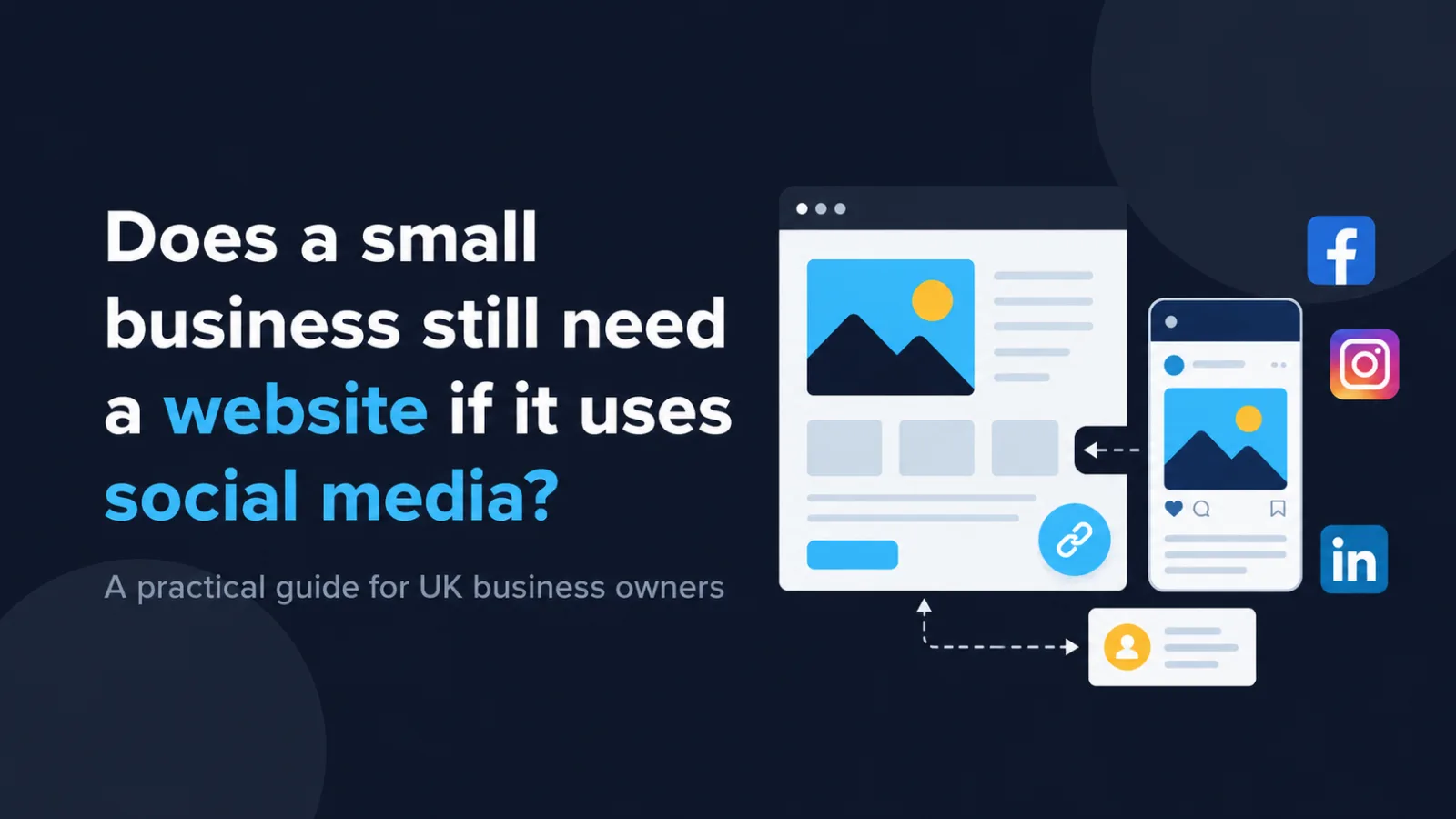
Does a Small Business Still Need a Website If It Uses Social Media?
Social media can attract attention, but a professional website gives your business greater control, credibility, Google visibility and a clearer route to enquiries.
Social media is useful, but it is not your online home
Instagram, Facebook, TikTok and LinkedIn can be excellent ways to show your work, speak to customers and build an audience. For some small businesses, a social profile is the first online presence they create.
But a social account and a business website do different jobs. Social media helps people discover and follow you. A website gives them a stable place to understand your services, check important details and take the next step.
You do not control the platform
Your social profile sits on somebody else’s platform. The layout, reach and rules can change without your permission. An account can be restricted, mistakenly suspended or lose visibility when an algorithm changes.
Your website is a space built around your business. You control the information, the customer journey and the way your brand is presented. Social platforms can support that website, rather than replacing it.
Customers often want more than a feed
A potential customer may enjoy your posts but still need clear answers. What exactly do you offer? Which areas do you cover? How much experience do you have? How can they request a quotation? What happens after they make contact?
On social media, that information may be spread across captions, highlights, old posts and direct messages. A well-structured website places it where visitors expect to find it.
A website can make your business feel more established
People regularly check a business online before getting in touch. A professional domain, clear service pages and a reliable contact route can make a small company feel more credible.
This is especially important when the customer is comparing several providers. An active social profile proves that the business is current. A professional website helps prove that it is organised, serious and ready to serve customers.
Google and social media are different types of discovery
People usually open social media to browse. They may discover a business even when they were not actively looking for one.
Google searches often show stronger intent. Someone typing “electrician near me”, “wedding photographer Portsmouth” or “accountant for small business” already has a need. A search-friendly website gives your business a chance to appear when that person is ready to act.
A social profile may appear in search results, but it rarely gives Google the same depth of structured, location-specific and service-specific information as a proper website.
Your website can turn attention into enquiries
Social content can generate interest, but sending every potential customer into direct messages creates friction. Messages can be missed, replies take time and the customer may not know what information to provide.
A website can guide visitors towards a clear action: call, request a quote, book an appointment, send an enquiry or read about a specific service. It can also answer common questions before the conversation begins.
Use social proof without giving up control
Your website and social media should work together. Embed recent work, link to active profiles and display genuine reviews or testimonials where appropriate.
This lets customers see that the business is active while keeping the essential information on a platform you control. A visitor can discover you on Instagram, visit the website to check the details and then make an enquiry with confidence.
When might social media alone be enough?
A social-only presence can be reasonable while testing a new idea, running a very small side project or serving customers entirely through a marketplace. It may also be enough when work comes solely through referrals and there is no immediate need to grow.
However, relying on social media becomes limiting once you want to rank in local searches, explain several services, look more established, collect structured enquiries or build an asset that belongs to the business.
The best approach is not website versus social media
The strongest approach is usually to use each channel for what it does best. Social media shows personality, recent activity and conversation. Your website provides clarity, trust, search visibility and conversion.
You do not need a huge or complicated website. A focused, professionally written site can give customers the information they need and provide a dependable destination for every social profile, advert, email signature and printed leaflet.
Build a presence that belongs to your business
Most small businesses still benefit from having a website even when social media is working well. The website does not replace your social channels; it makes them more useful by giving interested people somewhere clear and professional to go next.
Siverno creates and manages websites for UK small businesses that do not want the technical workload. We handle the design, wording, hosting, maintenance and ongoing support, so your website and social channels can work together.
Want results like this for your business?
Tell us what you need — we will get back to you within a day.