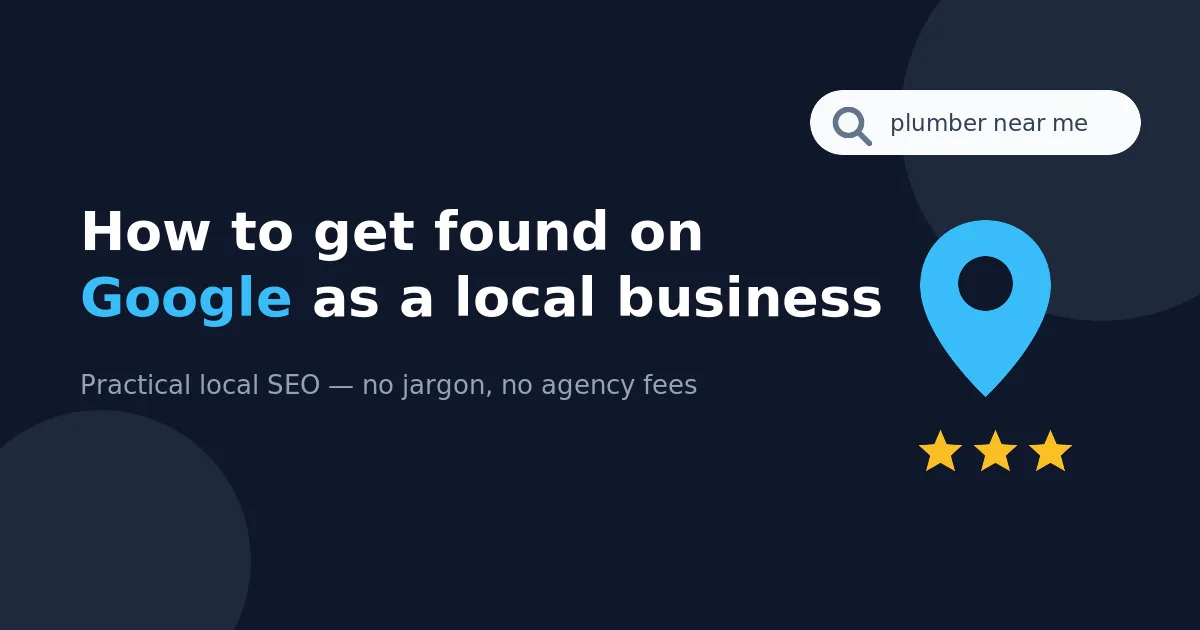
How to Get Found on Google as a Local Business
When someone nearby searches "plumber near me" or "accountant in Leeds", you want to be the business they find. Here's how that actually works — in plain English, without paying an agency a penny.
Local search is the highest-value marketing most small businesses will ever get, because the people searching are ready to buy right now. Nobody googles "emergency electrician" out of idle curiosity. The good news is that ranking locally isn't a dark art. It comes down to a handful of things done properly.
1. Claim and complete your Google Business Profile
That box with the map, photos, opening hours and reviews that appears when you search for a business? That's a Google Business Profile, it's free, and it's the single most important thing on this list. Claim yours at business.google.com, then fill in everything: categories, services, service areas, opening hours, photos of real work. Businesses with complete profiles get dramatically more calls and direction requests than those with bare-bones listings.
2. Collect reviews — steadily, not all at once
Reviews are the local ranking currency. They also do your selling for you: most people trust online reviews nearly as much as a personal recommendation. Make it a habit: every happy customer gets a polite text or email with a direct link to your review page. Two or three a month, consistently, beats a burst of twenty (which can look suspicious to Google). And always reply to reviews — including the awkward ones. A calm, professional response to a grumpy review often impresses readers more than the five-star ones do.
3. Say where you are and what you do — on the website itself
Google can't rank you for "roofer in Sheffield" if your website never mentions Sheffield. It sounds obvious, but a surprising number of business sites never actually name their town or the areas they cover. Your homepage should say plainly what you do and where: "Family-run roofing company covering Sheffield, Rotherham and Chesterfield." If you serve several areas, give the important ones their own short page describing your work there.
4. Get the technical basics right
You don't need to become an SEO expert, but Google quietly rewards sites that are fast, mobile-friendly and secure (the padlock in the browser bar), with page titles that say something useful — "Emergency Plumber in Bristol | Smith & Sons" rather than just "Home". If your site is professionally managed, all of this should simply be done for you; it's one of the things included with every website we rent out.
5. Answer the questions people actually type
People don't just search for services — they search questions: "how much does a boiler service cost", "do I need planning permission for a garden office". Every question your customers regularly ask is a blog post or FAQ entry waiting to be written, and each one is another doorway into your website. One good answer a month, patiently, compounds into serious visibility.
What about paying for ads?
Google Ads can work, but the moment you stop paying, you vanish. The organic work above keeps paying you back for years. Do the free foundations first; consider ads later as a top-up, not a substitute.
The one thing that underpins all of it
Every tactic here ultimately points somewhere: your website. If it's slow, dated or unclear, you'll lose people at the final step — like brilliant advertising for a shop with a broken front door. That's the part we take care of. Every website we provide comes with fast hosting, mobile-first design, proper page titles and a blog that's easy to update — the local SEO groundwork done for you, for one monthly fee. See how it works.
Want results like this for your business?
Tell us what you need — we will get back to you within a day.