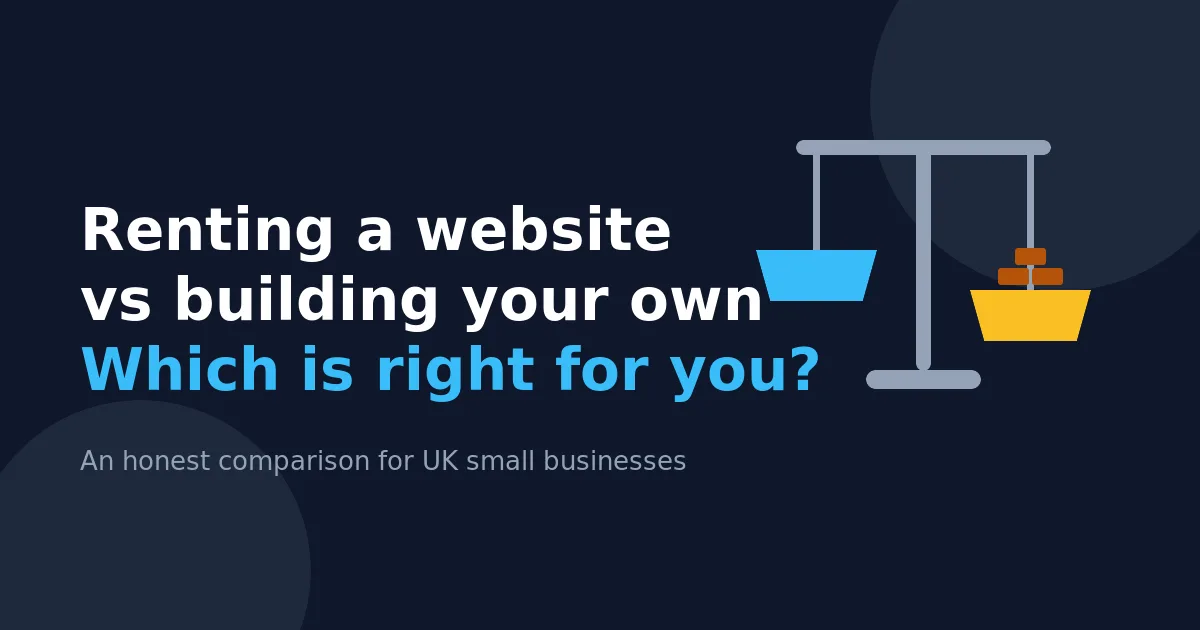
Renting a Website vs Building Your Own: Which Is Right for You?
Yes, we rent out websites for a living — so you'd expect us to say renting wins. Instead, here's the honest comparison we'd want if we were on the other side of the table, including the cases where renting is the wrong choice.
First, what does "renting a website" actually mean?
Instead of paying thousands upfront for a website you then have to maintain, you pay a monthly fee that covers the lot: design, the writing, hosting, security, email and ongoing changes. The provider builds it, keeps it fast and secure, and updates it when your business changes. Stop paying and the service ends — just like your phone contract, your accounting software or the van on lease.
Round 1: Upfront cost
Building means £500–£2,500 for a freelancer or £3,000–£10,000+ for an agency before you've earned a penny from it. Renting means no upfront cost — you start paying a monthly fee and the site is typically live within a week. For a new business watching its cash flow, this round isn't close. Renting wins.
Round 2: Long-term cost
Here's where it gets more interesting. Add up what "owning" actually costs: the build, plus hosting, domain, email, security updates and a designer's hourly rate for every change — then a redesign every three or four years, because websites age like cars, not like houses. Over five years the totals are usually much closer than people expect. If you genuinely never touch your site and nothing ever breaks, buying can come out cheaper. If you value predictability and zero surprise bills, renting does. Call it a draw — depends on your discipline.
Round 3: Time and hassle
With a built website, every update, plugin conflict, hosting renewal and security scare is your problem, or your freelancer's — if they still answer emails. With rental, it's the provider's problem, contractually. You email a change; it gets done. For owners already working sixty-hour weeks, this is usually the deciding factor. Renting wins.
Round 4: Ownership and control
The honest downside of renting: the website platform isn't yours. If you cancel, you don't keep the site (though with any reputable provider you always keep your domain name and your content — check this before signing with anyone, us included). If total ownership matters to you on principle, or you want highly bespoke functionality — complex bookings, a large online shop, custom software — buying a tailored build is the better route. Building wins.
So who should do what?
Build (or DIY), if: you have specific technical requirements, in-house skills to maintain it, and capital you're happy to spend upfront. Rent, if: you want a professional site live quickly, with no upfront cost, no maintenance and no technology decisions — and you'd rather spend your time on the business itself.
For most trades, local services and small firms — the plumbers, salons, consultants and builders this blog is written for — the website isn't the business; it's the shop window. Renting gets you a very good shop window without ever having to think about glass.
Questions to ask any website rental provider
Before you sign with anyone (again — us included), ask: Do I keep my domain name if I leave? Who owns the content and photos? What exactly is included in the monthly fee, and what costs extra? How quickly are changes made? Is there a minimum contract? A good provider will answer all five in plain English without flinching.
Ready to see the numbers? Our plans all include design, copywriting, hosting, email and UK-based support — and our answers to those five questions are in the FAQ. Most sites are live within a week.
Want results like this for your business?
Tell us what you need — we will get back to you within a day.